
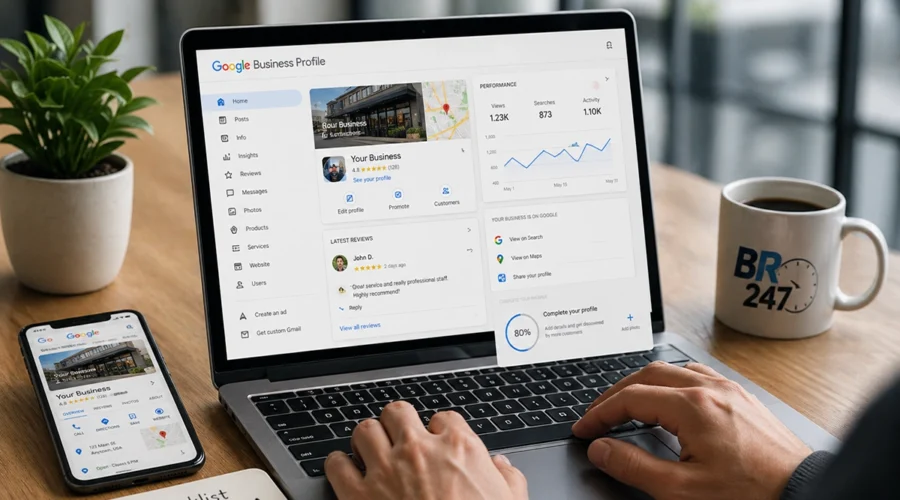
5 Ways to Improve Your Google Business Profile
For most local businesses, your Google Business Profile is no longer just a directory listing. It is your digital storefront, your first impression, and often your most important lead source.
When someone searches for “plumber near me,” “best dentist in Dallas,” or “personal injury lawyer in Phoenix,” Google usually shows the local map pack first. That means your Google Business Profile often gets seen before your website does. In competitive metro markets, that visibility can directly determine who gets the call and who gets ignored.
“I cannot give you the formula for success, but I can give you the formula for failure. It is: Try to please everybody.”
– Herbert Bayard Swope
The challenge is simple: most business owners claim their profile, add a few basics, and then never touch it again. Meanwhile, competitors are actively optimizing theirs and winning more calls, clicks, and booked appointments.
In practice, the businesses that consistently generate leads from Google Maps usually are not doing anything flashy. They are just doing the fundamentals better and more consistently.
If you want to improve your Google Business Profile and turn it into a stronger local lead channel, these five strategies deliver the biggest impact.

1. Complete Every Section of Your Profile
The fastest way to improve your Google Business Profile is also the most overlooked: fill out everything.
Google has been clear for years that local rankings are largely influenced by three factors: relevance, distance, and prominence. A complete profile improves relevance immediately because it gives Google more context about what your business does and who it should show your listing to.
At a minimum, every business should fully complete:
- Business name
- Primary category
- Secondary categories
- Business description
- Services
- Products (if applicable)
- Hours
- Holiday hours
- Phone number
- Website URL
- Appointment link
- Service areas
- Attributes
- Questions and Answers
This is where many businesses leave money on the table.
A roofing company may list “Roofing Contractor” as its primary category but fail to add secondary categories like “Siding Contractor” or “Gutter Cleaning Service.” A law firm may stop at “Personal Injury Attorney” and never add service details for car accidents, truck accidents, or wrongful death. A medical office may list general services but omit high-converting procedures patients actually search for.
That missing detail matters.
The more complete and accurate your profile is, the easier it is for Google to match your business to high-intent local searches.
One important note: use your real business name only. Do not stuff keywords into the business title. It may work temporarily, but it is one of the fastest ways to trigger profile issues or suspension.
2. Choose Better Categories and Services
Categories are one of the strongest local relevance signals in your Google Business Profile.
Your primary category tells Google what your business is. Your secondary categories help Google understand what else you do. Together, they heavily influence which searches your profile appears for.
This is where precision matters.
Too many businesses choose broad categories and stop there.
For example:
- A med spa should not just use “Medical Spa”
- A dentist should not just use “Dentist”
- A contractor should not just use “General Contractor”
Those categories may be technically correct, but they are often too broad to compete well in crowded markets.
A smarter approach is to pair your primary category with highly relevant secondary categories and then align your services beneath them.
For example, a dental practice might use:
- Dentist (Primary)
- Cosmetic Dentist
- Emergency Dental Service
- Pediatric Dentist
Then reinforce those categories with specific service listings like:
- Dental Implants
- Veneers
- Emergency Tooth Extraction
- Invisalign Consultations
This creates stronger topical relevance and gives Google more confidence in when to surface your listing.
From a practical local SEO standpoint, category strategy is one of the highest-leverage profile changes you can make because it improves visibility without requiring more reviews, more backlinks, or more ad spend.
3. Add Better Photos (and Add Them Consistently)
Photos are one of the most underused conversion assets in Google Business Profile optimization.
Most businesses upload a logo, maybe a storefront image, and stop there. That is not enough.
Photos improve both engagement and trust. They help prospects validate that your business is legitimate, active, and professional. They also improve interaction rates, which can influence profile performance over time.
The businesses that perform best usually add photos consistently, not just once.
For local businesses, the highest-value image types include:
- Exterior storefront photos
- Interior location photos
- Team photos
- Service-in-progress photos
- Before-and-after project photos
- Equipment or treatment room photos
- Product photos
- Branded vehicle photos
- Customer experience photos
This is especially important for service businesses.
A home service company with real project photos will almost always outperform one using stock images. A law office with authentic office and team photos builds more trust than one with generic branding graphics. A dental practice with real operatories, staff, and patient-friendly visuals will usually generate more engagement than one with no visual proof of experience.
In competitive local markets, better photos do not just improve aesthetics. They improve conversion.
And yes, consistency matters. Adding fresh photos monthly sends stronger business activity signals than uploading 20 once and disappearing for a year.
4. Build a Real Review Strategy
Reviews are not just reputation signals. They are local ranking signals and conversion signals.
That distinction matters.
A strong review profile improves visibility in Google Maps, but it also improves click-through rate once people find you. Searchers compare ratings, review volume, recency, and response quality before they ever visit your website.
This means your review strategy should focus on four things:
Volume
You need enough reviews to be competitive in your market.
Recency
Fresh reviews matter more than stale review volume.
Quality
Detailed reviews with service-specific language are stronger than generic one-liners.
Response Rate
Responding consistently builds trust and reinforces relevance.
A common mistake is treating review generation as a one-time campaign.
That is the wrong approach.
The businesses that perform best operationalize review requests. They build them into the customer process after a completed job, successful appointment, or resolved case milestone.
That means:
- Asking consistently
- Making it easy
- Sending customers directly to the review link
- Training staff to ask naturally
- Following up when appropriate
And just as important, respond to every review.
Review responses are public. Prospects read them. Google reads them too.
A thoughtful response improves trust, reinforces service relevance, and shows your business is active and engaged.
5. Post Weekly Updates to Keep Your Profile Active
Most businesses ignore Google Posts. That is a mistake.
While Google Posts may not be the strongest standalone ranking factor, they do support profile freshness, engagement, and conversion. More importantly, they signal that your business is active and current.
That matters more than many business owners realize.
An active profile tends to outperform a stagnant one, especially in competitive local markets where trust and engagement influence decision-making.
Weekly post ideas include:
- Promotions
- Seasonal offers
- New services
- Team updates
- Community involvement
- Case results
- Before-and-after jobs
- FAQs
- Customer tips
- Limited-time announcements
For example:
- A med spa can promote seasonal skincare packages
- A law firm can post recent case insights
- A roofing company can share storm damage tips
- A dental office can post insurance reminders
- A plumbing company can publish seasonal maintenance advice
These posts give searchers more reasons to engage and more confidence to convert.
From a practical standpoint, weekly posting is one of the easiest ways to keep your profile active without major time investment.
Common Google Business Profile Mistakes to Avoid
Even well-established businesses lose visibility because of simple profile mistakes:
- Using keyword-stuffed business names
- Choosing weak or irrelevant categories
- Letting hours become outdated
- Ignoring reviews
- Using stock photos instead of real images
- Never posting updates
- Leaving services incomplete
- Forgetting to update holiday hours
- Inconsistent business information across the web
These are small issues individually, but together they weaken trust, relevance, and conversion performance.
Final Thoughts
If you want to improve your Google Business Profile, start with the fundamentals and execute them consistently.
You do not need gimmicks. You do not need shortcuts. And you do not need to outspend larger competitors.
You need a more complete profile, stronger category targeting, better visual trust signals, a consistent review strategy, and regular activity.
That is what improves local visibility. That is what improves map pack performance. And that is what turns your Google Business Profile into a reliable lead source.
For most local businesses, the opportunity is not hidden. It is sitting in plain sight inside Google Maps.