
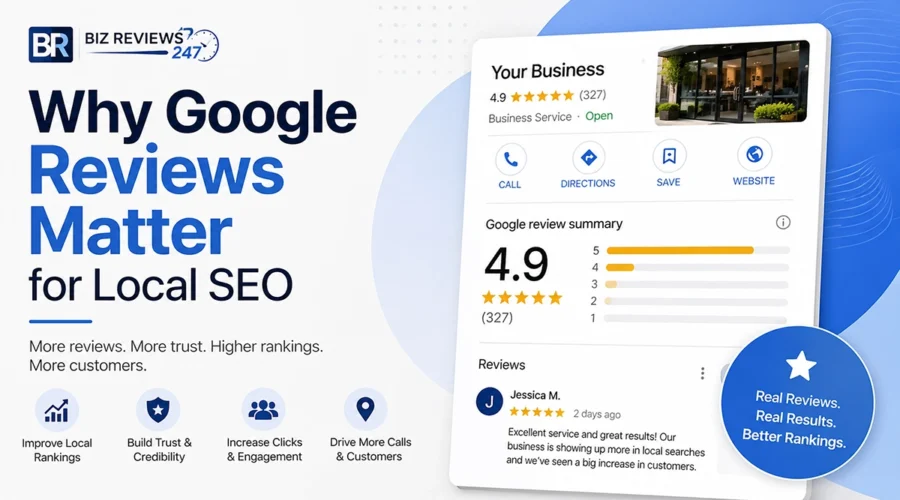
Why Google Reviews Matter for Local SEO
For local businesses, Google reviews do far more than shape public perception. They directly influence how often your business appears in local search, how much trust prospects place in your brand, and whether searchers become paying customers.
If you run a law firm, dental practice, HVAC company, restaurant, or multi-location business, your Google reviews are no longer just “social proof.” They are one of the most visible and influential local SEO assets you control.
“I cannot give you the formula for success, but I can give you the
formula for failure. It is: Try to please everybody.”
– Herbert Bayard Swope
In practical terms, reviews affect three outcomes that matter most in competitive local markets:
- Where you rank in Google’s local pack and Maps
- Whether prospects trust you enough to click or call
- How often search impressions turn into revenue
That combination is exactly why Google reviews have become one of the most important local SEO levers for service-area businesses and brick-and-mortar brands alike.

At BizReviews247, we’ve seen this play out repeatedly: businesses with strong review velocity, consistent response management, and high review quality tend to outperform better-designed websites with weaker reputation signals. In competitive local search, reviews are no longer optional. They are a ranking signal, a trust signal, and a conversion signal all at once.
Google Reviews Are a Direct Local Ranking Signal
Google has never been vague about what drives local rankings. According to Google, local results are primarily influenced by three factors: relevance, distance, and prominence.
Reviews sit squarely inside that third category: prominence.
Prominence reflects how established, trusted, and well-known your business appears online. Google uses review quantity, review quality, review recency, and review sentiment as strong trust indicators when determining which businesses deserve more visibility in local search.
This means reviews influence far more than reputation. They influence discoverability.
A business with more high-quality, recent, and relevant reviews often sends a stronger prominence signal than a competitor with fewer reviews or stale engagement. That becomes especially important in competitive markets where proximity and category relevance are already similar across competing listings.
In real-world local SEO campaigns, this is often where ranking separation happens. When two businesses have comparable websites, citations, and on-page optimization, review strength frequently becomes the deciding factor.
Reviews Help You Rank in the Local Pack
The local pack—Google’s map-based top three listings—is the most valuable real estate in local search.
It appears above most organic listings, dominates mobile search visibility, and captures the majority of high-intent local clicks. Businesses in the local 3-pack receive significantly more calls, clicks, and direction requests than businesses ranked below it.
That matters because local customers often make decisions directly from the search results page without ever visiting your website.
They compare:
- Star ratings
- Review count
- Recency of feedback
- Owner responses
- Photos
- Overall trust signals
In many local searches, your Google Business Profile is the first impression and the conversion point.
This is why review visibility matters so much. If your listing shows 18 reviews and a 4.1-star rating while your competitor has 214 reviews and a 4.8-star rating, the ranking battle is already uphill before a user even clicks.
Reviews influence whether you appear in the local pack—and whether searchers choose you once you do.
Review Quantity Matters, But Review Quality Matters More
A common local SEO mistake is assuming review count alone wins.
It doesn’t.
Review quantity matters because it signals business activity and customer engagement. More reviews generally strengthen prominence and help Google trust that your business is active, legitimate, and relevant. One 2025 local ranking study found review count was among the strongest local ranking factors, especially for top map pack visibility.
But volume without quality has limits.
Google also evaluates:
- Review sentiment
- Review detail
- Review freshness
- Reviewer legitimacy
- Keyword relevance in review text
A review that says, “Great service” has some value.
A review that says, “Fast emergency AC repair in Dallas, fair pricing, and same-day service” carries significantly more contextual value for both users and search engines.
Detailed reviews reinforce service relevance. They help Google better understand what your business does, where you do it, and why customers trust you.
That is one reason high-quality reviews often outperform raw review volume in competitive service categories.
Review Recency Is One of the Most Overlooked Local SEO Signals
One of the clearest patterns in local SEO is this: stale reviews weaken trust.
A business with 180 reviews but no new feedback in six months often underperforms a business with 95 reviews and steady weekly review activity.
Why?
Because recency signals business activity.
Fresh reviews tell Google your business is still operating, still serving customers, and still generating engagement. They also reassure prospects that your reputation is current—not inherited from two years ago.
This is especially important for:
- Medical practices
- Legal firms
- Home service businesses
- Restaurants
- Multi-location brands
In these categories, consumer trust is highly time-sensitive. People want recent validation, not outdated praise.
From a reputation management standpoint, review recency is one of the most practical advantages a disciplined local business can build. You do not need thousands of reviews. You need consistent review momentum.
Google Reviews Improve Click-Through Rates and Conversions
Even when reviews do not move rankings immediately, they still influence performance where it matters most: conversions.
A stronger review profile improves:
- Click-through rate (CTR)
- Call volume
- Form fills
- Booking actions
- Direction requests
- Lead conversion rates
This happens because reviews reduce uncertainty.
Local buyers compare businesses quickly. Reviews help them answer critical questions fast:
- Can I trust this company?
- Do they actually deliver?
- Are they responsive?
- Are other customers satisfied?
- Is this worth my time and money?
Reviews reduce friction in that decision-making process.
That matters even more in high-trust categories like legal, healthcare, and home services, where consumers are evaluating risk as much as service quality.
In practice, we often see businesses focus too heavily on traffic and not enough on trust conversion. Reviews solve both problems. They help you earn more visibility and convert more of the visibility you already have.
Review Responses Strengthen Trust and Engagement
Many businesses ask for reviews.
Far fewer manage them well.
That is a missed opportunity.
Responding to reviews—especially consistently—strengthens both customer trust and local engagement signals.
A thoughtful review response shows prospects that your business is active, attentive, and accountable. It also sends Google an engagement signal that your profile is being maintained.
This matters for two reasons:
- It improves trust with prospective customers
- It reinforces profile activity and reputation health
Owner responses also help mitigate negative reviews.
A bad review without a response damages trust.
A bad review with a calm, professional, solution-oriented response often improves trust because it demonstrates accountability.
For medical practices, law firms, and service businesses, this can be one of the most overlooked conversion advantages in local search.
Reviews Influence More Than Rankings—They Shape Brand Trust
Local SEO is no longer just a visibility game.
It is a trust game.
Google reviews sit at the intersection of both.
They influence how Google evaluates your prominence, how users evaluate your credibility, and how quickly prospects decide whether to contact you.
That makes reviews more than a local SEO tactic. They are part of your brand’s trust infrastructure.
This is especially true in competitive U.S. markets where local searchers compare multiple businesses in seconds and often make decisions directly from Google Maps.
A stronger review profile creates compound value:
- Better local visibility
- Higher click-through rates
- Stronger trust
- Better conversion rates
- More efficient lead acquisition
That is why review strategy should be treated as a core revenue function—not just a reputation task.
Common Google Review Mistakes That Hurt Local SEO
Many businesses understand reviews matter. Fewer manage them strategically.
The most common mistakes include:
1. Asking inconsistently
Review generation should be ongoing, not occasional.
2. Ignoring negative reviews
Silence weakens trust more than criticism.
3. Prioritizing quantity over quality
Specific, relevant reviews carry more SEO and conversion value.
4. Letting reviews go stale
Recency matters more than most businesses realize.
5. Using risky review tactics
Fake, gated, or incentivized reviews create compliance and trust risks. Google has increased scrutiny around suspicious review behavior and fake review patterns.
The Bottom Line
Google reviews matter for local SEO because they influence the three metrics local businesses care about most: visibility, trust, and conversions.
They help Google decide whether your business deserves to rank.
They help customers decide whether your business deserves their trust.
And in competitive local markets, those two decisions are tightly connected.
For businesses that want stronger local rankings, better lead quality, and higher conversion rates, Google reviews are not a secondary tactic.
They are one of the most important local growth assets you have.