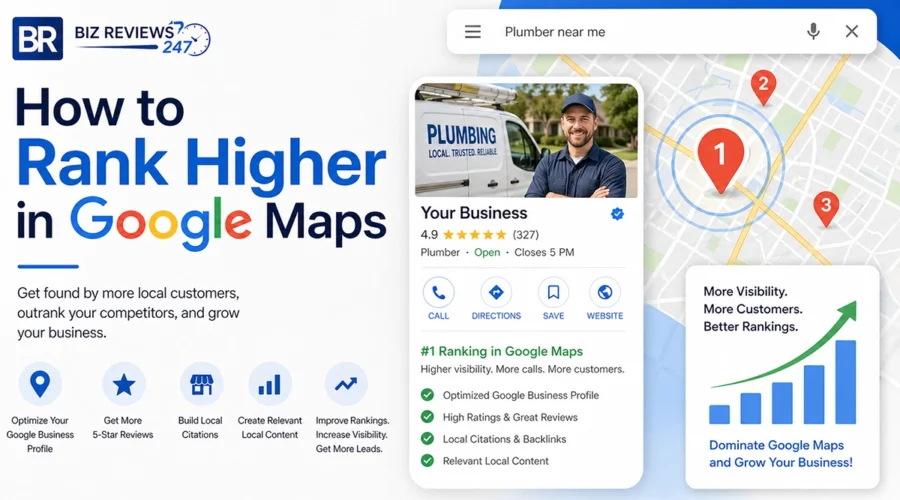
How to Rank Higher in Google Maps
O One of the principal decisions that startup owners have to make is whether or not to engage in SEO. One common consideration is the cost of investing in an SEO campaign versus possible returns. Another is tRanking higher in Google Maps is one of the fastest ways to generate more local leads, calls, and booked appointments—especially in competitive metro markets where buyers compare businesses directly inside Google before ever visiting a website.
For most local businesses, Google Maps is no longer just a navigation tool. It is the new local storefront.
Whether you run a law firm, plumbing company, med spa, dental office, HVAC business, or multi-location brand, your Google Maps visibility directly impacts how often local customers find you, trust you, and contact you.
And in most cases, the businesses that rank highest in Google Maps are not simply the closest. They are the most relevant, the most trusted, and the most optimized.
That distinction matters.
At BizReviews247, we regularly see businesses with stronger Google Maps SEO outperform larger competitors with better branding, bigger budgets, and older domains—simply because their local search signals are more complete, more relevant, and easier for Google to trust.
If your business is not consistently showing in the Google Maps 3-pack, the issue usually is not luck.
It is structure.

How Google Maps Rankings Actually Work
Google has made the core ranking framework for local results very clear: local visibility is primarily based on relevance, distance, and prominence.
These three signals drive nearly every Google Maps ranking outcome.
Relevance
Relevance measures how closely your business matches what someone is searching for.
If someone searches “emergency plumber,” Google evaluates whether your business clearly signals that service through your Google Business Profile, website content, categories, services, and supporting local relevance.
The clearer the match, the stronger the relevance signal.
Distance
Distance reflects how close your business is to the searcher—or the location included in the query.
This is the hardest Google Maps ranking factor to control, especially for service-area businesses. But it is also one of the most misunderstood.
Google does not simply rank the closest business. It ranks the best local match based on distance plus relevance and prominence. That is why a better-optimized business can outrank a closer but weaker competitor.
Prominence
Prominence reflects how trusted, established, and authoritative your business appears online.
This includes:
- Google reviews
- Review quality and recency
- Local backlinks
- Brand mentions
- Citation consistency
- Website authority
- Google Business Profile engagement
Prominence is often what separates businesses competing for the same map positions in the same market.
Fully Optimize Your Google Business Profile
Your Google Business Profile is the single most important asset for ranking in Google Maps.
It is the foundation of local visibility.
An incomplete or poorly optimized profile weakens relevance, trust, and engagement—three things Google relies on heavily in local rankings.
To improve Google Maps visibility, your profile needs to be fully completed and actively maintained.
That includes:
- Accurate business name
- Correct primary category
- Strategic secondary categories
- Complete services
- Business description
- Hours of operation
- Service areas
- Products (if applicable)
- Attributes
- Photos
- Appointment links
- Messaging (if appropriate)
Google itself recommends completing every section of your profile to improve local visibility because profile completeness helps Google better understand your business relevance.
In practice, category selection is one of the most influential ranking levers here. Your primary category has an outsized impact on which searches you can rank for in Maps.
Get that wrong, and everything downstream gets harder.
Choose the Right Primary Category
One of the most common reasons businesses struggle to rank in Google Maps is poor category targeting.
Your primary category is one of the strongest relevance signals in your Google Business Profile.
It tells Google what your business is first.
That matters because Google Maps rankings are query-dependent. A personal injury lawyer, criminal defense lawyer, and family law attorney may all be law firms—but category alignment affects which searches they appear for.
The same is true for:
- HVAC contractor vs. air conditioning repair service
- Cosmetic dentist vs. dentist
- Med spa vs. skin care clinic
- Roofing contractor vs. roof repair
Your primary category should reflect your highest-value core service, not just your broadest business type.
Secondary categories expand visibility, but primary category alignment often determines whether you compete at all.
Build Strong Review Signals
Google reviews are one of the strongest prominence signals in Google Maps SEO.
They influence:
- Map rankings
- Click-through rates
- Trust
- Conversion rates
- User engagement
Google has explicitly stated that more reviews and positive ratings can improve local ranking.
But not all review strategies create the same ranking impact.
To rank higher in Google Maps, focus on:
- Consistent review velocity
- High average star rating
- Detailed review content
- Recent reviews
- Owner responses
A business with steady weekly reviews typically sends a stronger trust signal than one with occasional bursts followed by long inactivity.
This is especially true in competitive service categories where review recency heavily influences both trust and conversions.
Improve Your Website’s Local Relevance
Google Maps rankings are not driven by your profile alone.
Your website plays a direct supporting role in Maps performance—especially in competitive markets.
Google uses your website to validate local relevance, service clarity, and authority.
That means your website should reinforce what your Google Business Profile claims.
Key local SEO elements that help Google Maps rankings include:
- Location-specific service pages
- Optimized title tags and H1s
- Local schema markup
- Embedded map
- Crawlable NAP information
- Internal links between related service and location pages
- Strong service-area relevance
For multi-location businesses, each location should have its own dedicated landing page—not a generic location directory with thin content.
For service-area businesses, your city pages need to be useful, localized, and structurally distinct.
Google rewards clarity.
Build Local Authority With Citations and Links
Prominence is not built inside Google Business Profile alone.
Google also evaluates how consistently and credibly your business is referenced across the web.
That includes:
- Local directory citations
- Industry-specific listings
- Chamber of commerce profiles
- Local sponsorships
- Local news mentions
- Geographic backlinks
Citation consistency still matters because it reinforces trust in your business identity.
Your name, address, phone number, and website should match across your core local listings.
Beyond citations, local backlinks remain one of the strongest off-profile authority signals in competitive Maps SEO.
In practice, a few strong local links often outperform dozens of weak directory submissions.
Improve Behavioral Signals
Google Maps rankings are also shaped by how users interact with your listing.
Behavioral signals can include:
- Click-through rate
- Calls
- Direction requests
- Website clicks
- Photo views
- Review engagement
- Time spent interacting with your profile
While Google does not publish these as direct ranking factors, engagement patterns often correlate strongly with stronger Maps visibility because they reinforce user trust and listing usefulness.
This is one reason conversion-focused Google Business Profiles often perform better over time.
A profile that earns clicks, calls, and interactions sends stronger quality signals than one that gets impressions but little engagement.
Add Fresh Photos and Ongoing Activity
Google wants active, trustworthy businesses in local results.
Fresh profile activity helps reinforce that your business is real, maintained, and operational.
That includes:
- New photos
- Updated hours
- Seasonal changes
- Service updates
- Review responses
- GBP posts
Posts are not typically considered a direct ranking factor, but profile activity contributes to stronger engagement and trust signals over time.
For many businesses, this is one of the easiest competitive advantages to build because most competitors neglect profile maintenance entirely.
Common Google Maps Ranking Mistakes
Businesses often struggle in Google Maps because of avoidable structural mistakes.
The most common include:
1. Choosing the wrong primary category
This weakens relevance from the start.
2. Using a weak or incomplete Google Business Profile
Missing services, categories, and attributes reduce ranking clarity.
3. Neglecting reviews
Low review velocity weakens prominence and trust.
4. Sending all traffic to the homepage
Location-specific pages usually create stronger local relevance.
5. Ignoring local links and citations
Prominence requires off-profile authority.
6. Expecting fast results in competitive markets
Google Maps SEO compounds. Stronger signals build stronger rankings over time.
The Bottom Line
If you want to rank higher in Google Maps, the goal is not to “game” Google.
It is to become the clearest, most trusted, and most locally relevant result in your market.
That means improving the three signals Google already tells us matter most:
- Relevance
- Distance
- Prominence
You cannot control every ranking factor.
But you can control how clearly Google understands your business, how much trust your brand earns, and how strong your local authority becomes.
And in competitive local markets, that is what moves businesses into the map pack—and keeps them there.